
6.1 KiB
| id | title | section | difficulty | estimated_time | prerequisites | objectives | tags |
|---|---|---|---|---|---|---|---|
| fund-04 | Phase Angles and What They Mean | Fundamentals | beginner | 20 | [fund-01 fund-02 fund-03] | [Distinguish between impedance phase φ_Z and admittance phase φ_Y Understand the relationship φ_Z = -φ_Y Interpret the physical meaning of different phase angles Learn why -45° is considered "balanced" Recognize typical phase angles for Tesla coil sparks] | [phase-angle impedance admittance power-factor] |
Phase Angles and What They Mean
Introduction
Phase angles tell us about the balance between resistive and reactive components in our circuit. Understanding what different phase angles mean physically helps us interpret circuit behavior and optimize performance.
Impedance Phase vs Admittance Phase
Impedance phase angle φ_Z:
φ_Z = atan(X/R) = atan(Im{Z}/Re{Z})

Interpretation:
φ_Z > 0: inductive (current lags voltage)
φ_Z = 0: purely resistive (in phase)
φ_Z < 0: capacitive (current leads voltage)
Admittance phase angle θ_Y:
θ_Y = atan(B/G) = atan(Im{Y}/Re{Y})

Relationship: θ_Y = -φ_Z (OPPOSITE SIGNS!)
Why opposite? Because Y = 1/Z, so angles subtract:
If Z = |Z|∠φ_Z, then Y = (1/|Z|)∠(-φ_Z)
Convention in this framework: We primarily discuss impedance phase φ_Z because that's what measurements typically report.
The "Famous -45°" and Why It's Special
In power electronics, a load with φ_Z = -45° is sometimes called "well-matched" because:
- Equal resistive and capacitive components: |R| = |X_C|
- Power factor = cos(-45°) = 0.707 (reasonable power transfer)
- Not maximum power transfer, but balanced
Formula: For φ_Z = -45°:
tan(-45°) = -1 = X/R
Therefore: R = |X| = 1/(ωC) for capacitive load
Or: R ≈ |X_C| = 1/(ωC_total) approximately
This is why you'll see "spark resistance should equal capacitive reactance" in old Tesla coil literature.
BUT: As we'll see in the next lesson, achieving exactly -45° is impossible for many Tesla coil geometries due to topological constraints!
Physical Meaning of Phase Angle
Let's explore what different phase angles mean for circuit behavior.
φ_Z = 0° (purely resistive):
- All power dissipated
- No energy storage/return
- Voltage and current in phase
- Power factor = cos(0°) = 1.0 (100%)
φ_Z = -45° (mixed):
- Some power dissipated (cos(-45°) ≈ 71% of |V||I|)
- Some energy stored
- Current leads voltage by 45°
- Equal R and |X|: balanced condition
φ_Z = -90° (purely capacitive):
- No power dissipated
- All energy stored and returned each cycle
- Current leads voltage by 90°
- Power factor = cos(-90°) = 0 (no real power)
For Tesla coil sparks: Typical φ_Z = -55° to -75°
- Significant capacitive component (energy storage in C_mut, C_sh)
- Moderate power dissipation (plasma heating)
- More capacitive than the "ideal" -45°
Worked Example: Calculating and Interpreting Phase Angle
Given: (from previous lesson)
- Z_total = 49.7 - j182 kΩ
Find: φ_Z and interpret
Solution:
Step 1: Calculate phase angle
φ_Z = atan(X/R) = atan(-182/49.7)
φ_Z = atan(-3.66) = -74.8°
Step 2: Verify with magnitude and components
|Z| = √(49.7² + 182²) = √(2470 + 33124) = √35594 = 189 kΩ ✓

cos(φ_Z) = R/|Z| = 49.7/189 = 0.263
φ_Z = arccos(0.263) = 74.8°, but X is negative, so φ_Z = -74.8° ✓
Step 3: Interpret
- Strongly capacitive: |φ_Z| = 74.8° is much larger than 45°
- Comparison: |R| = 49.7 kΩ, but |X| = 182 kΩ
- Capacitive reactance is 3.66× larger than resistance
- Far from "balanced" -45° condition
- Power factor: cos(-74.8°) = 0.263
- Only 26.3% of |V||I| is real power
- Most current is reactive (charging/discharging capacitances)
This is typical for Tesla coil sparks: strongly capacitive impedance.
Visualizing Phase Angles
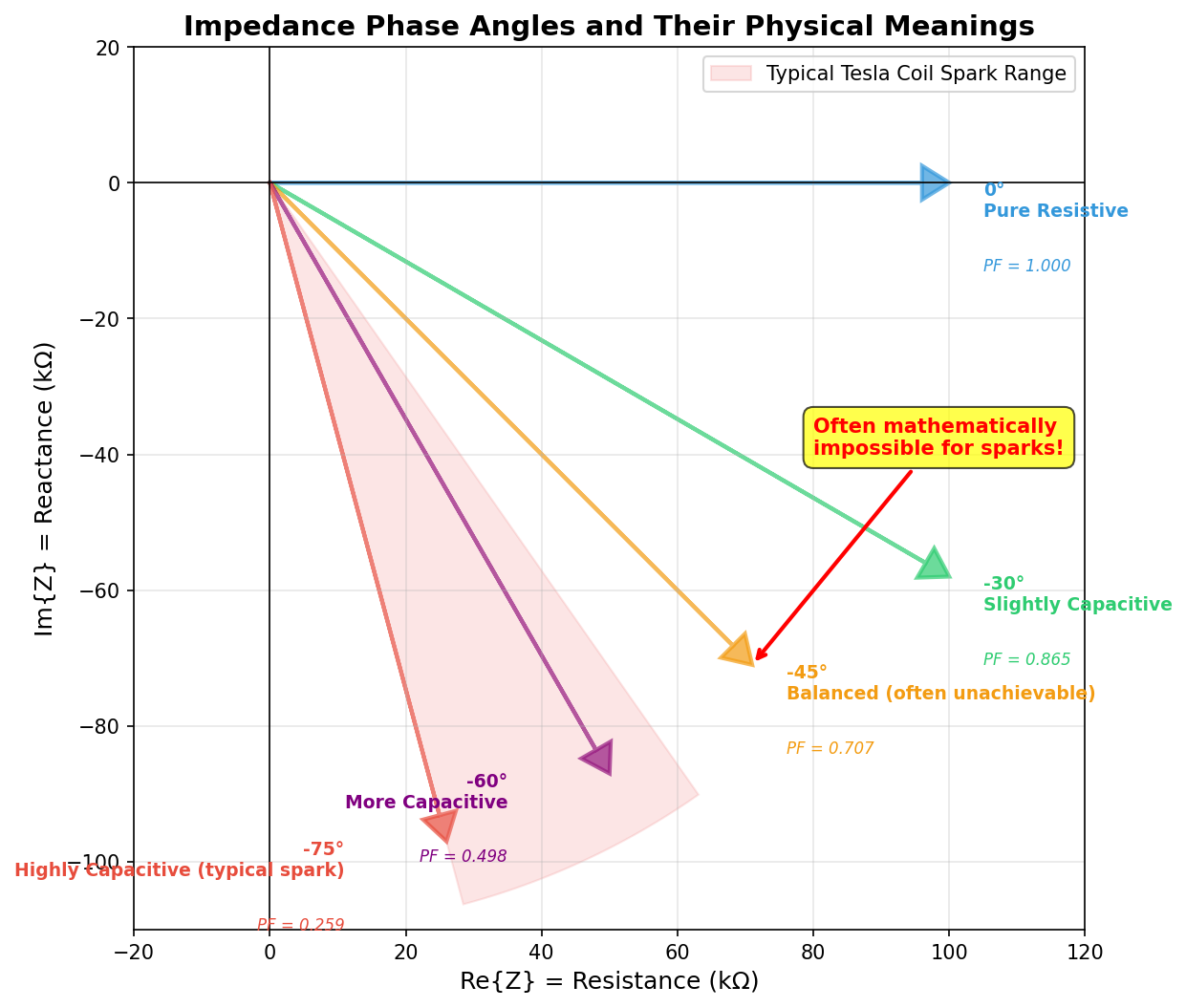
Impedance plane (Z = R + jX):
Three key vectors from origin:
-
Resistive (φ_Z = 0°):
- Horizontal vector along R axis
- Pure resistance, no reactance
- All power dissipated
-
Balanced (φ_Z = -45°):
- Vector at -45° angle
- Equal R and |X|
- Traditional "well-matched" condition
-
Typical spark (φ_Z = -75°):
- Vector at -75° angle
- Strongly capacitive
- |X| >> R
Key regions:
- φ_Z = 0°: Pure resistance (horizontal axis)
- φ_Z = -45°: Balanced point
- -45° to -90°: Typical Tesla coil spark range (shaded region)
- φ_Z = -90°: Pure capacitor (vertical downward)
Note: More negative φ_Z means more capacitive behavior
Relationship to Power Factor
The power factor relates phase angle to real power delivery:
Power Factor = cos(φ_Z)

Real Power: P = 0.5 × |V| × |I| × cos(φ_Z)
Reactive Power: Q = 0.5 × |V| × |I| × sin(φ_Z)
Examples:
| φ_Z | Power Factor | % of Maximum Power |
|---|---|---|
| 0° | 1.00 | 100% |
| -30° | 0.866 | 86.6% |
| -45° | 0.707 | 70.7% |
| -60° | 0.500 | 50.0% |
| -75° | 0.259 | 25.9% |
| -90° | 0.000 | 0% |
Tesla coil sparks typically operate at 25-50% power factor - much energy is reactive (stored and returned each cycle) rather than dissipated in the plasma.
Key Takeaways
- Phase relationship: φ_Z = -φ_Y (opposite signs)
- Negative φ_Z: means capacitive (current leads voltage)
- φ_Z = -45°: balanced condition with R = |X|
- Typical sparks: φ_Z ≈ -55° to -75° (strongly capacitive)
- Power factor: cos(φ_Z) determines fraction of power dissipated
- More capacitive → lower power factor → less efficient power transfer
Practice
{exercise:fund-ex-04}
Problem 1: An impedance Z = 60 + j40 kΩ. Calculate φ_Z. Is this inductive or capacitive?
Problem 2: A spark has φ_Z = -60°. If |Z| = 150 kΩ, find R and X. Calculate the power factor.
Problem 3: Two sparks have the same |Z| = 200 kΩ. Spark A has φ_Z = -50°, Spark B has φ_Z = -70°. Which dissipates more power for the same applied voltage? By what factor?
Next Lesson: The Phase Constraint